When we think about paper applications, we usually focus on the final packaging, its appearance or its role in front of the consumer. But paper can also play a part inside industrial processes themselves, meeting highly specific needs that often go unnoticed.
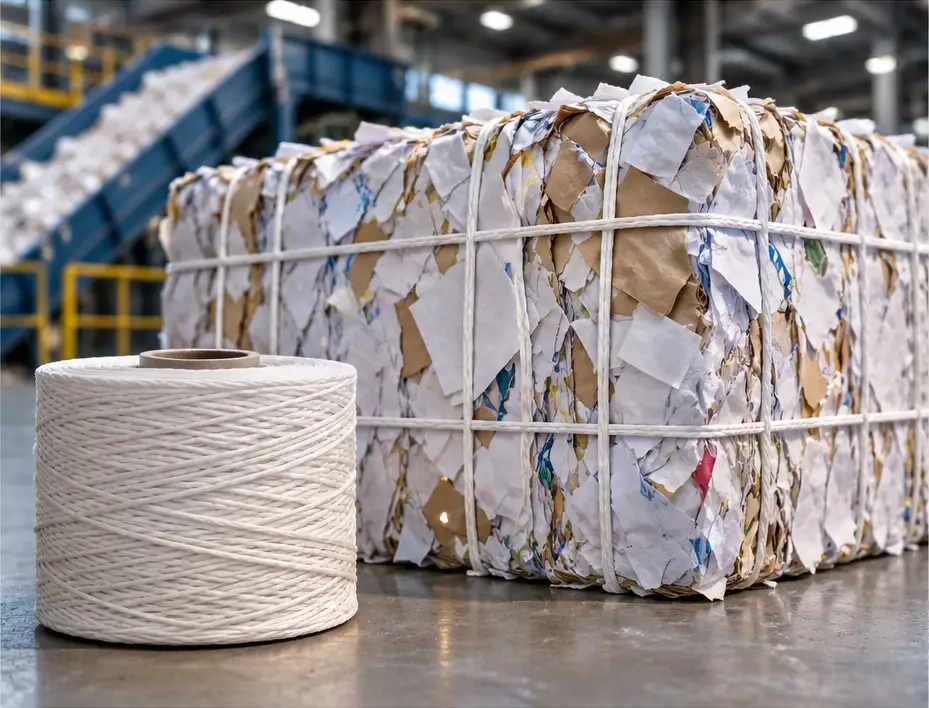
A good example is the use of paper cords for tying recovered paper bales.
It is a discreet application, yet a very meaningful one. It shows a particular way of understanding innovation: not simply producing a paper-based product, but developing technical solutions made from paper to solve real industrial needs.
A discreet application with a strong message
In the paper recovery and recycling process, material is collected, sorted, compacted and transported in bales. This requires a tying system that keeps the bale stable during handling and transport.
This is where paper cords come in.
Their role may seem simple at first glance, but what they represent is far more interesting: paper becomes a technical resource that helps organise, secure and accompany paper itself into a new stage of its journey.
Circular bioeconomy, in practical terms
Circular bioeconomy is sometimes discussed in very broad terms. Its real value becomes clearer when we see it in specific applications.
This is one of them.
We are talking about a solution based on a renewable material and integrated into an industrial logic consistent with the paper cycle. Under suitable operating conditions, these cords can be part of a system that helps manage recovered paper efficiently.
Whatever their sales volume may be, their real communication value lies in what they stand for: an intelligent way of extending the possibilities of paper beyond its most obvious uses.
MIMCORD: applied paper technology
At MIMCORD, transforming paper strips into yarns and cords is not only a manufacturing speciality. It is also a way of exploring new applications, new markets and new functions for a material that still has much more to offer.
Paper cords for tying recovered paper bales are a clear example of this. They show that innovation does not always mean creating something spectacular. Sometimes it means solving a specific need in a smart and coherent way.
And they also express a powerful idea:
paper can help paper continue its journey