For many years the debate around the circular economy has focused mainly on the end of the product cycle. Recycling, material recovery and waste management have been at the centre of public policies and corporate communication.
However, the European regulatory framework is gradually introducing a different perspective. Increasingly, the analysis incorporates variables that appear earlier in the cycle: the origin of materials, the traceability of supply chains and the stability of the production systems that support them.
This shift is significant because it moves the focus from waste management to the architecture of the system itself. When the full cycle is considered, the nature of the raw material stops being a secondary factor and becomes a structural element.
In this context, renewable materials occupy a particularly strong position. Paper is a clear example. Its raw material comes from managed natural resources, its traceability can be verified and its industrial recovery and recycling system has been operating at scale for decades.
The European paper industry has developed consolidated infrastructures that allow fibre to be recovered, reintegrated into the production process and extend the value of the natural resource. This is not a future aspiration but a functioning system that already forms part of the sector’s industrial reality.
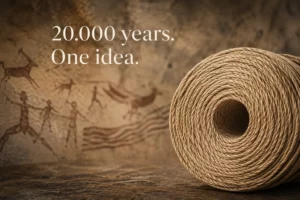
At Mimcord we work precisely at one of the points where this system takes shape in the market: the development of paper handles and paper-based solutions for bags and packaging. These components, apparently simple, are part of a broader system that connects the renewable origin of the material with its capacity to integrate into reuse and recycling loops.
From this perspective, circularity does not depend only on what happens when a product reaches the end of its use. It begins much earlier, in the choice of materials and in the solidity of the industrial system that supports them.
When the origin is renewable, traceability is possible and recovery infrastructures operate at scale, the cycle stops being an aspiration and becomes an operational reality.